"I'm a shy person with a great sense of style and I like to be healthy.
The rare red squirrel finds refuge in pockets of mixed species, coniferous woodland.
A solitary and agile creature, it spends most of its time living in trees. It relies on trees for shelter and as a varied and reliable source of seeds and nuts."
My favourite colour is red, and from a very early age I have always loved red squirrels and foxes for their red fur colour. My two favourite woodland creatures. I have only once seen a red fox in real life, in the dark rummaging around some bins on it's nightly walk. Only round the corner from where I live, amazing to think such beautiful woodland creatures can live amongst us and we have no idea they are there.
I've never seen a red squirrel in the flesh, though I do have plenty of grey squirrels in my town, both in the park, and happily living amongst the trees down the side of the local supermarket. They always strike me as cute and happy creatures. I think the phrase 'bright-eyed and bushy tailed' probably comes from them, and I am happy to say I have been called that before, indicating a bubbly happy-go-lucky personality. I always get a little thrill whenever I see these happy little creatures. I hope you do too.
What's your favourite Woodland Creature? Why not take the Woodland Trust's quick test, to see Which Woodland Mammal Are You?
Photo Credit: Both images courtesy of the Woodland Trust Media Library (WT/ML)
Would you like to enjoy live music, get a little exercise, and hear inspirational words to help save the planet? Knowing that you would be making a difference to woods and trees, and attempting to reverse Climate Change at the same time? Well you can, because the People's March for Woods and Trees will enable you to do just that!
There are over 2000 events taking place across our whole planet next weekend, on the 28th and 29th November 2015. In the UK, they will be taking place in all the capital cities, as well as many smaller events dotted across the country. I've listed the main city events below, but if you would like to attend a smaller event closer to you, you can find them on the Global Climate March Event Finder (as well as those across the planet too - just type in your country, city, or zip / post code for your area).
Climate Change
It's all in aid of drawing attention to the importance of Climate Change, the damage it is doing to our planet, and to bring it to the attention of our Global World Leaders who will be deciding what action will be taken on the next global climate deal, which they will be negotiating in Paris on Monday 30th November.
These days climate change is having a much bigger impact on the world. Instead of the scientists just predicting it, we can see the changes greenhouse gases are having on the planet. The rising temperatures of global warming are creating freak weather patterns, causing extended heat waves, snow in countries not used to having it (such as Egypt), and violent storms.
These weather patterns are effecting our seasons, making them more erratic, slower to start, and causing confusion to the plants and animals of this planet. In my own garden this year, I have witnessed shrubs that should have been shedding their leaves, instead they are flowering in October and November, confused by the milder weather we have been having. October is the month when weather normally turns drastically colder in the UK, causing trees to shed their leaves. This year, insects have been flying around when they should be hidden away. Small animals that normally hibernate at this time of the year, like our garden Hedgehog, are still active when they should be sleeping through winter.
This change in the timing of natural events can cause a loss of synchrony, so species that rely on each other, are now out of step with one another. Some animals will do much better, whilst others will struggle, breaking up the natural balance between the two. We are also more at risk of having non-native invasive species, who are not meant to be in our country, taking over and driving out native species, due to a changed weather climate that ordinarily would not allow them to thrive here. This is how our native plants and animals who are quite common now, can become endangered and possibly extinct in the future.
Woods and Trees can really help to alleviate this problem. With trees storing carbon, they help reduce greenhouse gas emissions which are changing our climate. The more trees the better. Trees and woodland also ease problems with flooding, they drink up water through their roots, which also helps hold waterlogged land together, preventing landslides during periods of heavy rain (which we seem to be having rather a lot of in England at the moment!). Trees can also provide a renewable source of winter fuel, reducing the need for fossil fuels which are adding to the problem.
The time to act on Climate Change is now. Many people believe we are almost at the point of no return, with scientists discovering new data which suggests sea levels could rise 10 times faster than previously predicted. If emissions aren't cut, they believe "multi-meter sea-level rise would become practically unavoidable. Social disruption and economic consequences of such large sea-level rise could be devastating. It is not difficult to imagine that conflicts arising from forced migrations and economic collapse might make the planet ungovernable, threatening the fabric of civilization."
This makes me think of my own island that I live on, England. After the Ice Age, sea levels rose that cut off England from mainland Europe. If the ice continues to thaw now due to global warming, will sea levels rise above my country? Will I effectively be homeless? I hadn't thought of my own country possibly being submerged underwater, and my country's population (myself included) becoming refugees seeking higher ground on which to live. You can well imagine that on any remaining high ground, the people already occupying that land would not be so keen to accept migrants. Suddenly life in the movie Waterworld doesn't seem quite so much science fiction, as potentially science fact.
Marching for Change
I believe we need to show our world leaders not only that we care, but that they must take action now, or this planet will look very different in the near future, a change which may well become irreversible.
The major events taking place in the capital cities of the United Kingdom are:
Belfast, Northern Ireland
Sunday 29th November 2015
A rally with live music and speakers hosted by Niall Bakewell from Friends of the Earth.
Cardiff, Wales
Saturday 28th November 2015
A bike ride and rally with speakers and live entertainment hosted by Delphine. You can choose to take part in either the bike ride, or rally, or both!
Edinburgh, Scotland
Saturday 28th November 2015
You are invited to wear your brightest colours for an inspirational rally with speakers and live music at the iconic Ross Bandstand, hosted by Rea Cris.
London, England
Sunday 29th November 2015
The People's March for Climate, Justice and Jobs will be marching right up to Westminster, and culminating with a rally with live music and a range of speakers, hosted by Fatima Ibrahim.
The London People's March will be putting on coaches from various points all over the country to help supporters get there. Check out The Climate Justice website for more informaiton.
If you'd like to take part on one of the major events above, you can sign-up on The Woodland Trust People's March page, where they can keep you up-to-date with the latest news on routes and meet-up places, and if you meet up with them on the day of the march, they will even give you a biodegradable Woodland Trust poncho and a placard to carry!
If you'd prefer to take part in a smaller event closer to you, or in your own country, don't forget you can check out the Global Climate March Event Finder, which has all the events in all countries, with details of what will be happening at each event.
Some of the other events around the UK will include fancy dress in Southport, poets, circus acts and inspirational speakers in Canterbury, as well as many candlelit vigils around the country with words of inspiration and music to shine a light of hope for our planet.
Around the world people will be showing their world leaders they care too, in New York City, USA, they will be holding their first annual NYC World Climate Festival / March where people will be marching to Times Square with singing, dancing, talking, listening and laughing. There will also be people marching in Canberra, Australia, where they will be having music, speeches and stalls in a family friendly Community Festival of Solutions, inspiring people towards action and change.
Whatever you do, make sure you go out there and have fun, show you care about the future of our planet, and ultimately, all life on Earth.
I’ve always loved anything
miniature and small. As a child, I loved
reading The Borrowers by Mary
Norton. I was intrigued by Arrietty, the
young daughter of a family of Borrowers, tiny people who lived under the
floor. When they emigrated in The Borrowers Afield I loved exploring
the great outdoors through her eyes, discovering giant grass and hedges to
climb, beautiful flowers, giant buzzing bees, mice and frogs. And so began my love of nature. I used to imagine my miniature self, running
barefoot across the moss in my garden.
This glossy green carpet is perhaps one of the most ancient of plants, having
no roots or stems, nor true leaves. Many
varieties of moss thrive in the ancient woodland of the British Isles. It grows over rocks and soil, tree bark and stone
walls.
Lichens also grow on the bark of
trees, and are similar in that they have no roots, and absorb water all over
their surface. They need moist humid air
within which to grow, and the best place to spot them is in damp ancient
woodland. Because they absorb water from
the air around them, many varieties of lichens cannot survive near motorways or
human habitation due to the pollutants in the air, such as sulphur dioxide and
carbon monoxide, which dissolve in the water in the air that they drink. In these areas only Pleurococcus, a microscopic alga that turns tree trunks a dirty
green colour, seem able to survive. In
ancient woodland you see a much more varied and exciting variety of lichens,
including Tree Lungwort (Lobaria
pulmonaria), one of the largest lichens with large light green leaf shapes
growing over tree trunks, whose presence is often an indicator of ancient
woodland.
Ancient woodland is rare in that
it has undisturbed, and very rich soil.
It has not been ploughed or turned over by man for centuries, if at
all. It often dates back to the last Ice
Age, and in deciduous woodland, has been fed every year with the falling leaves
in autumn. Deciduous trees also enable
the prolific growth of another key ancient woodland indicator species – the English
Bluebell (Hyacinthoides non-scripta). They flower and leaf early in the growing
season, making the most of the available light before the tree canopy closes in
late spring, giving a beautiful carpet of colour so typical of British woodland,
and much loved pollen and nectar for our humble Bumblebees.
Ferns are also well adapted to
woodland, these shade loving group of plants are one of my favourite. I love how each leaf gradually uncurls from
the centre, extending out into beautiful light green fronds, it’s like
unwrapping a present. Large ancient trees
in Britain harbour many beautiful little rare treasures, like the Golden
Hoverfly (Callicera spinolae), large
furry hoverflies that more closely resemble a honeybee, except that they have
long black antennae that are white at the tips.
The adults are active in September and October, often feeding on nectar
rich ivy as it is one plant which offers nectar and pollen at this time of the
year. Golden Hoverfly tend to lay their
eggs in ancient trees that have been pollarded, where wet rot holes have often
formed, or in the snags and complex branch structures of these old trees.
Perhaps the most elegant and
beautiful creature of ancient woodland, is the Purple Emperor Butterfly (Apatura iris). This Butterfly can appear black and white
from some angles, but when the sunlight strikes the wings at just the right
angle, a magnificent purple sheen is revealed.
This Butterfly spends most of its time up in the tree canopy feeding on
aphid honeydew, although it’s rather unusual diet does bring it down in the
early morning and again in the late afternoon, when it will feed on animal
droppings, carrion, moisture from damp mud, and have even happily landed on
human observers to feed on their sweat!
Another beautiful butterfly is
the Silver-washed Fritillary (Argynnis
paphia), a bright orange butterfly named after the silver streaks found
underneath its wings. This Fritillary is
most often found in woodland where it’s larval food plant, the Common
Dog-violet (Viola riviniana),
grows. As adults, they feed on aphid
honeydew in the woodland canopy, but also their favourite nectar sources, the
flowers of Bramble and Thistle. The Silver-washed Fritillary is a strong
flyer, hurtling along through the tree canopy searching for anything that might
be food, and investigating anything remotely orange coloured in case it might
be a potential mate. Their courtship
flight is the most spectacular of all though, with the paler orange female
flying in a straight line, whilst the male continuously flies in loops all
around her, before eventually landing on a convenient spot where the male
showers her in scent scales. How
romantic!
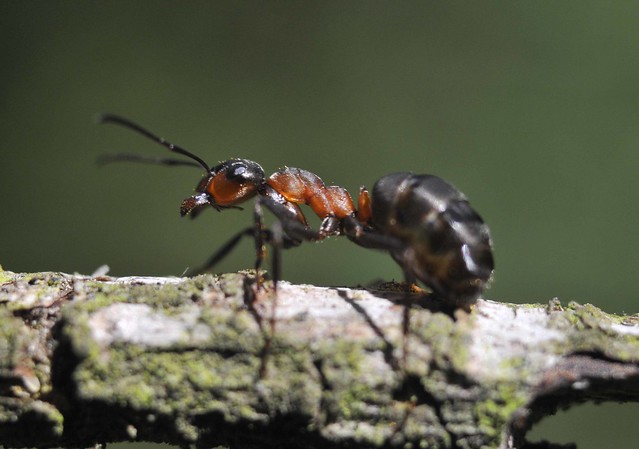
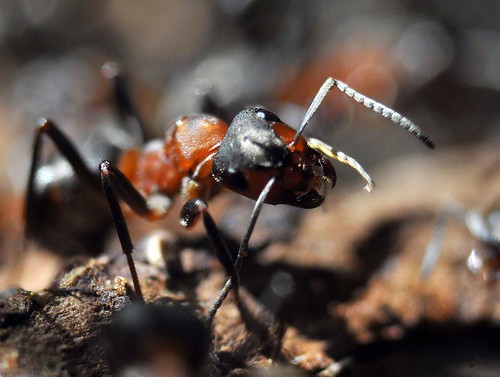
Important managers of ancient
woodland are the rare and often overlooked are the Narrow Headed Ants (Formica
exsecta), recognised by a deep notch at the back of their head. Even though they are only 10mm long, they
play an important role in helping to regenerate forests. Certain plants are dependent on ants for
distribution of their seeds. For
example, Small Cow Wheat (Melampyrum
sylvaticum), produces seeds with a small sweet attachment which attracts
the ants. The ants carry the seeds to
their nest, where they will consume the yummy food, before taking the seeds out
of the nest and disposing of them somewhere new where they will germinate into new
plants the following year. Ants must
have a sweet tooth too!
Narrow Headed Ants are also
surprisingly green in their way of living. Masters of eco architecture, they build large
dome-shaped nests around a tussock of grass or some similar plant, which
provides not only the foundation of the nest, but also heat as the vegetation
decays within their nest. They also
build their nests asymmetrically, with the larger and flatter side facing
south, so as to get the maximum heat from the sun on their nests. The worker ants also go out sunbathing, before
returning to the nest and using their now heated bodies to warm and help
incubate the eggs. They also thatch
their roof with a covering of grass, heather and pine needles, insulating their
home from the cold. I guess when you’ve
gone to so much trouble to make your home so nice, you can understand how wood
ants can be very territorial, and Narrow Headed Ants are no exception. They have been known to climb onto the backs
of other ant species, and decapitate them from behind, literally biting their
heads off! Perhaps they’ve watched one
too many zombie movies?
If you’re looking for more scary
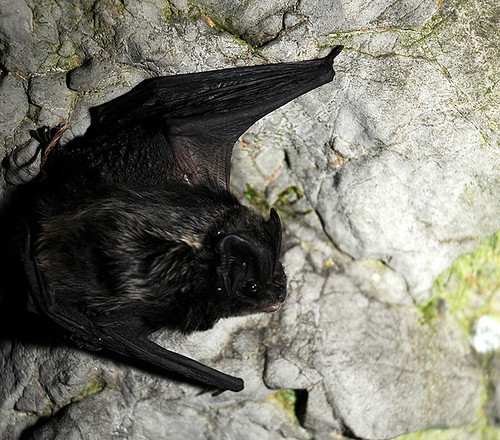
creatures of the forest, there are a couple of rare bats, the Barbastelle Bat (Barbastella barbastellus) and Bechstein’s
Bat (Myotis bechsteinii). I think the Barbastelle Bat is probably the
scarier looking of the two, being mostly black and pictured here in caves. It’s kind of ironic to think that humans used
to live in caves, and these days most of us tend to have a fear of Bats
flapping around us, how did we ever manage to live in caves with them? Surely we must have come across them in the
past, or is that where our fear of them first came from? Did we inadvertently spook them with a noise,
or was it just their time to fly out, and we happened to be in the way when
they went?
Apparently, Bats roost in
different locations at different times, depending on whether they just want
somewhere to sleep for the day, a breeding roost, or a hibernation roost. For breeding, they prefer higher treetops,
just under the canopy, where the sun will keep the females and their babies warm. Non-breeding adult females, and males, prefer
hollows and damaged spots in older or dead trees to keep cool in for sleeping
during the day. But in winter, they need
somewhere cooler, to allow their body temperatures to drop, preferably quiet
where they won’t be disturbed, and somewhere with a consistent
temperature. Perhaps in the base of an
old tree, but Bats would also find caves ideal for this. Perhaps they would hibernate deep in caves,
whereas prehistoric man would be nearer a cave’s entrance making small fires to
keep warm. Then come springtime, a whole
swarm of Bats could come flying out, surprising and terrifying humans, who
would have had no idea they were there!
I think the cutest creature of
the UK’s forests has to be the Dormouse (Muscardinus
avellanarius), a quick search on GoogleImages brings up many gorgeous pictures to melt your heart. Dormice are so sweet, with tiny human-like
hands, cute faces, golden brown fur, and a fluffy tail. They spend most of their time sleeping, they
sleep all day long, and hibernate up to seven months a year. They wake up in April, and spend their
nocturnal lives searching for food amongst the branches in the trees, often
taking long detours and leaping from branch to branch rather than having to
risk the danger of predators on the ground.
They tend to feed on flowers and pollen in the spring, fruit during the
summer, and nuts in the autumn. Their
favourite food is hazelnuts and bramble, whose flowers and berries can sustain
them for quite some time, but they can also eat aphids and caterpillars. The trees really do hold all they need, even
giving them nesting material, and hollows within which to build their nests
close to the ground for winter hibernation.
Over recent years, Dormice are in
decline. Because of their specialised
diet, and because of their fear of crossing open ground, dormice are restricted
to ancient woodland sites, they cannot cross open ground to colonise other
sites when their woodland habitat is destroyed.
All the species I have mentioned today are especially adapted to ancient
woodland, many are rare and threatened.
Amazingly, only 2% of the British Isles is covered in ancient woodland,
and only half of it is in a semi-natural condition. The other half has been planted with exotic
and invasive species, such as conifers and rhododendron, spoiling the biodiversity
and making it difficult or impossible for our native species to survive
there. These woodlands need careful
management, with the maintenance of native species of flora and fauna, to bring
the woods back to what was originally here in these woodlands. We cannot bring back the species that are
already extinct, but we can use what we’ve learned to protect the threatened
species barely hanging on to our British countryside.
The National Planning Policy
Framework (NPPF) is meant to protect special sites like these, to protect the ancient
forests of Britain and its inhabitants from extinction. But their wording has provided a huge
loophole allowing any potential developers to bulldoze straight through the
land. This is what it says:
“Planning
permission should be refused for development resulting in the loss or
deterioration of irreplaceable habitats, including
ancient woodland and the loss of aged or veteran trees found outside
ancient woodland, unless the need for, and benefits of, the development in that
location clearly outweigh the loss.”
How can any benefit of
development outweigh the loss of such a beautiful habitat and the amazing
species within it, which could be lost forever?
The Woodland Trust believe this wording is as much use as a
chocolate teapot. The wording should be
changed to ancient woodland loss being “wholly
exceptional.” The UK government disagrees,
they believe there is adequate protection, despite there being absolutely no
evidence to back that claim up. What do
you believe? Do you want to protect our
amazing and precious species?